Road trip from Adelaide to Cape York….The Story
This is the story of our intrepid, somewhat epic and definitely disorganised road trip from Adelaide to the northernmost point of the Australian continent on Cape Yorke, and back. In total we travelled for 8 months, from June 2012 to February 2013, and covered an impressive 25,000 kilometres, due to the many detours and side trips that we took. We were not the best prepared of travellers, given some of the conditions we encountered along the way, and it turned out to be a remarkably adventurous and demanding journey.
We will endeavour to add to these reflections over the coming weeks/months until it is complete, giving, we hope, an interesting account of where we went, some of the amazing places we saw along the way and the many adventures we had.
Adelaide to Arkaroola
We left Adelaide in our newly acquired Toyota Landcruiser packed to the gunnels inside, and with a roof rack loaded just within sensible limits. Someone commented that had we had a goat strapped to the roof rack we might well have looked the part in Africa! Squeezed in between all the camping accoutrements were our dear little children Miriam, Hannah and Esther, at that time they were aged 4, 2 and 9 months respectively. With no particular plan in mind except to head to warmer climes in Queensland we departed Adelaide on 28th June, 2 months later than we had hoped. The balmy days of Autumn were long gone and the Adelaide Hills were firmly in the grip of winter. We drove up the driveway and away from Wildflowers as the insipid light of a wet and cold winter day faded along with the prospect of arriving anywhere that day other than the home of some friends in the northern suburbs.
When we eventually cleared the city the next day, Liadhan and the children had all come down with a nasty cold and flu like symptoms. The further north we travelled it became dryer but colder and colder, and with the family unwell it was not practical to camp out in our tent or swags. For 6 nights we paid for accommodation and did all we could to stay warm and to help the children to recuperate. At Burra the beautiful stone built Paxton Square Cottages were so cold and the heating so inadequate that we lived most of the 2 days that we were there holed up in the kitchen with every heater we could find turned on as well as the cooker stove and hot plates going full bore! At night we retreated to the beds which had electric blankets.


Further north at Carrieton, the house we rented for a couple of nights was warm, and here at least, for a couple of hours in the early afternoon, the sun would wrestle itself from behind the clouds and bath us in its lethargic rays. Here the children showed signs of getting better and we pushed on to Angorichina. It was not until we arrived at Arkaroola in the northern Flinders Ranges where the days were warmer, and the children feeling a little better, that we broke open the tent and swags and began camping out.


It was a difficult first week but it was made more than bearable by the open road before us, the hum of our tyres on the bitumen and, in the distance, the beckoning view of the Flinders Ranges and all that vast desert country beyond. We were together as a family, on our own, and the adventure had begun.

Arkaroola
Arkaroola in the northern Flinders Ranges turned out to be our first bush camp. We set up our tent and rolled out our swags as far as we could from the Arkaroola village, about five kilometres away, and a good kilometre or so from any other campers. In the eleven days we ended up staying there we saw only 2 other people and 1 car pass by, and it had to turn round because the track didn’t go any further than our camp.

We located ourselves at the edge of a dry creek bed hemmed in by sheer rock face on one side and a steep rise on the other with the only access being the single vehicle dirt track. Besides the odd foray into the village we were quite alone.
This was the first time we had had to unpack the whole vehicle since we left Adelaide. At our other stops we had the convenience of using bedding and accessories at the accommodation we stayed at. Nonetheless when we did reach a destination or when we stopped along the road for lunch every conversation seemed to begin with “Where’s the-“… “where’s the cutlery?”, “where’s the salt and pepper?”, “where’s the cups?”, and on it went. Nothing seemed to have any order! It was hardly any better when we got to Arkaroola, in fact it was a minor calamity.
As I made up the swags, I yelled out, “where’s the big double feather quilt?, to which Liadhan replied “you took it out and put it on the roof rack when we stopped at Copley for lunch, did you put it back in”? The temperature that night dropped to minus 2 degrees! Liadhan and I went to bed fully clothed, using every jacket, towel and spare sheet we could muster to try and keep warm. It was a long cold night. Next day we went to the village and told the staff of our plight. They had a single quilt to spare and we could have it for a donation to the Royal Flying Doctor Service. We survived another couple of nights and then drove the 260 kilometre round trip to Leigh Creek and bought a double quilt. We didn’t make that mistake again!

Cold and frosty mornings did not deter us from having a swag out under the stars


Arkaroola is a most beautiful place, and to us our camp was the most beautiful place in Arkaroola. While the nights and early mornings continued to be bitterly cold, as the day went on there was a real heat in the sun that totally banished the chills. The sky was azure blue and as the sun dipped away in the late afternoon the rock faces took on the bright golden ochre hue so familiar in the Flinders Ranges.


We kept the fire going most of the day to cook and boil water on and spent our days there, in the main, sitting at camp reading and resting or going on short excursions on foot or by car. The children were creative in using whatever came to hand to make elaborate games and make believe scenarios. They were particularly adept at turning rocks, gravel and sticks into all sorts of make believe games.


It was here that we began to realise that camping and living out of the back of a Toyota with three little children was a lot of hard work. I have lost count of how many times I walked up what became known as ‘Poo Hill’ to empty the potty into the hole I’d dug! Dressing them for the cold of the evening, getting them into warm pyjamas at night and then back into warm clothes in the morning, keeping the dusty clothes and the clean clothes separate; the cooking over an open fire, and washing up in a bowl on the ground. That said, nothing in the whole trip required more stamina than getting up out of a warm swag in the middle of the night to take children to the potty!
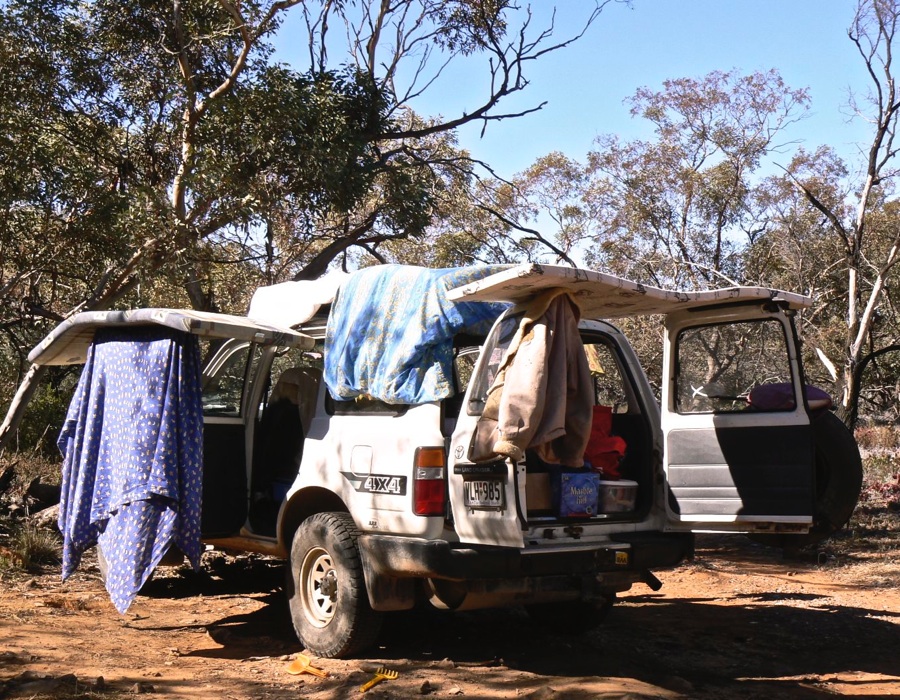
We were really quite poorly equipped as far as luxuries were concerned. We didn’t have a table or chairs for example, instead we made our swags into a couch and we ate with our plates on our knees. Oh! but it was so very cosy, with us all cuddled together in our swags in the tent or sitting round the fire toasting our hands and feet with a big pot of chicken stew bubbling in the camp oven. We could look up at the sky and see the stars, and the nights and days were still and quiet without the noise of another soul nearby.


Our plan was to stay a few days and then head north on the dirt road to Mount Hopeless and then onto the Strzelecki track heading to Innamincka. Alas, that route was closed due to the poor conditions as a result of rain that had fallen before we arrived. So we decided to wait for it to dry out and open again. On day seven at Arkaroola, as we lay snuggled together in our tent and sound asleep, a storm invaded our tranquil setting. The thunder growled and cracked, reverberating with fierce and threatening intent off the cliffs and hills around us, then the clouds released torrents of rain upon our camp and tent. The lightening lit up our space and we could see as if it were daylight. Then the storm moved on as quickly as it had charged in, the furore replaced by a quiet calm that was broken only by a gentle tinkling noise right outside our tent. I raised myself from my swag and went to investigate. The small creek that we were camped next to was in full flow, the water hurrying over the sand and pebbles and racing away into the night. By morning the creek bed was dry again.

That deluge meant we stayed eleven days at Arkaroola before the track to Mount Hopeless opened to traffic. Then, with a tinge of sadness we packed up our belongings and left our first camp driving on to the next part of our adventure.