In ‘Where it all began’ I wrote that not many people want to employ a 58 year old labourer. Well maybe that’s not so true. I have been doing quite a bit of labouring the last few months, and I am now 60, sometimes for money and sometimes in exchange for things that I have wanted.
I suppose I am glad that I did not find any physically demanding work when I resigned from my office job, then I was flabby and very unfit and such work would have probably ruined me. I also had a gammy knee which was causing me great aggravation and considerable pain. Even though I was not in a good physical state I yearned to be doing something that would engage my body in activities that it was designed for, something that would use my muscles, rather than sitting in front of a computer for most of the day.
I also longed for work for which I had something tangible to show at the end of my labours. I loved to come home from work and get into the garden, seeing the lawn raked clean of leaves, the lawn neatly mowed or the vegetable garden weeded and mulched gave me a sense of satisfaction that my day job never really produced. In addition I wanted to be outside in the weather, to feel the cold if it was cold, the rain if it was raining and the wind and the sun on my face. I wanted to be tired at the end of the day not exhausted by 2 hours on the bus and with bleary eyes from fluorescent lights and computer screens.
A while back I was talking to a friend in Scotland, an elderly man who has since passed away. We spoke by phone on numerous occasions across a range of subjects. I got talking about the agrarian movement that is happening in America, people moving back onto the land, getting back to basics and forsaking the lifestyle that has become so addictive since the onset of the industrial revolution. Donald was quite adamant that this was a very retrograde step and one I should not encourage anyone to venture upon. He said he remembered the days of his childhood and youth on a small croft in the Highlands of Scotland and of watching his older brother pulling a plough and working the land late into the evening in all sorts of weather. He reckoned that no-one should have to return to that sort of ‘drudgery’ . My response was that if he wanted to see drudgery at work he just had to travel on my bus to work every morning and see the streams of people pouring into office blocks in the city and watch the reverse in the evening, that’s ‘drudgery’, said I.
God has been very gracious in releasing me from the ‘round eternal of the cheque book and the journal’. I live on a small holding at Wildflowers and my days are full of outside work, in all weathers, it is physically demanding and I have so much to be satisfied about at the end of each day. I have laboured with a cow for the past 13 months, I bought it as an 8 week old calf, I have carted water to it by hand, moved it and electric fencing from paddock to paddock in all sorts of weather sometimes wondering why on earth I ever bought a cow. Last week we slaughtered and butchered it (itself an enormous task) and now when I see the freezer full of meat and as the family feast on a slow cooked beef roast, I can look back on all that hard work with great satisfaction.
Anyway, I have been doing some work for a guy who is renovating an old house, chiselling, jackhammering gardening etc. While I was labouring away one day I began thinking about a book I read called ‘the ‘Diary of a Welsh Swagman’. What made me think about it was that the man who wrote it was doing labouring work into his seventies. Also there was something of a parallel to my own situation, at the age of 51 he made a complete change in his life direction, much more dramatic than mine I might add, and, he liked to write.
I came across the ‘Diary of a Welsh Swagman‘ at an exhibition which toured Australia called ‘National Treasures from Australia’s Great Libraries’. The treasures included Ned Kelly’s helmet, the original script of ‘Waltzing Matilda’, the last convict uniform from Tasmania, the first ever drawing of the star constellation called the Southern Cross and a diary kept on toilet roll by an Australian prisoner of war in Japan. I have to say that I found the Australian ‘treasures’ presented at this exhibition much more interesting/fascinating than many of the historical treasures that I have been privileged to see in various countries across the globe. There is something in the recentness of Australian history since European settlement, that makes it almost ‘touchable’, it has a reality that an event such as the Battle of Hastings in 1066 does not have.
Out of all the exhibits on display the one that really caught my eye were these diaries of Joseph Jenkins who left Wales in 1869 took a boat to the fledgling colony of Victoria in SE Australia and became an itinerant labourer or ‘swagman‘ as they were known. No reasons were given as to why he made such a drastic decision.

He travelled around outback (country) Victoria seeking work, and working hard. He also kept a diary in which he recorded and commented upon ordinary, sometimes even mundane, details about everyday life and the people he met at that time. He was in many respects an astute social and political commentator. He probably never thought that his observations would one day provide a fascinating insight into what life was like during the early settlement of Victoria. In January 1880 he notes;
“As we worked in the paddock, the funeral of a neighbour filed past; I counted thirty-one carriages, and there were many people on horseback”; and later, “On this Sunday I climbed on to a hill, 500 feet high, and surveyed the countryside. It was a very pleasing sight with the paddocks packed with stooks of precious grain, gathered through the assiduous labour of the swagman, whom they variously abuse and call loafer, vagabond, and sundowner”.
In 1883 he comments;
“…an Irish farmer named Michael Owen was charged with assault on a lady, when he bit her thumb, almost amputating it. He was acquitted on payment of expenses. At the same court, three youths …were charged with taking ten potatoes which they had cooked directly to appease their hunger. They were committed to jail for three months. Michael Owen is a good customer at the provision store owned by the senior magistrate”.
He also had some good words to say about the local aboriginal people and not so good things to say about his contemporaries, in 1873 he wrote;
“When a native discovers a (bee) hive he invites the neighbours to partake of the honey, but when a white Christian discovers it, he keeps the produce for himself”.
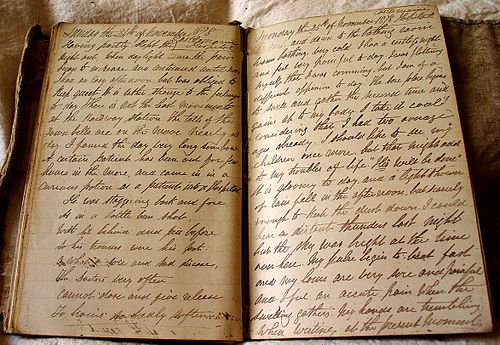
For the 25 years that he was in Australia he kept a diary, these 25 volumes were acquired in 1997 by the State Library of Victoria, Melbourne and cover the years 1869–1894.
In 1894 at the age of 76 Joseph Jenkins returned to Wales apparently because of homesickness. What a wonderful legacy this man left us and what an encouragement to those who may think that it is too late to make a change, have an impact and make their mark!


You can buy a book of selected entries online (although I think it is now out of print), in my case I borrowed a copy from our local library. It is well worth the reading.

That’s my great great grandfather you found!
Wow! Thats fantastic! I just love the story of your great-great-grandfather! Thanks for commenting on my post Anne, I am thrilled! It was such a treat to hear from the direct descendants of someone that intrigues me and captivates my imagination so much. No doubt you were aware of his diaries being an Australian ‘national treasure’? And so they should be. He hit a nerve in the Australian psyche, in some ways the 25 years he spent here and his exploits made him seem more Australian than Welsh and more Australian than Australians. Are his diaries considered a Welsh national treasure as well? Do many people in Wales know of his extraordinary Australian adventures? I love the quote that is on the plaque ‘Through this (diary) I am building my own monument’..how poetic and as it turned out, how true were those words. I bet he never thought his diaries would become an Australian national treasure. Why did he leave Wales? Why did he go back? Both moves seemed so sudden and unexplained?????? I also received a comment from Peter Jenkins telling me where Josephs’ remains are buried. I have a son living in Bristol so when next I’m in the UK I’ll try and get out that way and visit the grave. Do you live nearby that location? kind regards Richard
His body is buried at Capel-y-Groes Unitarian Chapel, Llanwnnen, Lampeter, Wales on the family plot.
Hi Peter…Thanks very much for that info…I have replied to Anne so you can see there that I am thrilled to hear from you both…your comments brought Joseph’s diaries to life! What an amazing contribution he made to Australia’s historical records, Australian literature and social commentary of the times in which he lived. I feel a visit to his last resting place would round of my remarkable discovery of a remarkable man. kind regards, Richard
I am a distant relative. My maternal great grandfather’s sister Betty was Joseph Jenkins’ wife. Their daughter Nell was the mother of the author of the Swagman’s Diary, the highly reputed cardiologist Dr Will Evans.
Thanks for that information John…I really enjoyed the diary excerpts. Receiving the comments from various relatives of Joseph has been a real treat, somehow it makes the man and his story so much more real!
There’s a very good, well-written biography of JJ by historian, Bethan Phillips – ‘Pity the Swagman:’
http://www.amazon.co.uk/Pity-Swagman-Australian-Odyssey-Victorian/dp/1902416473
Thanks for that recommendation Dinah, it is on my ‘to read’ list. Interesting title?
Hi Richard, I bought this book over 40 years ago and brought it out again to reread during this Coronavirus isolation and note in November 1887 he makes reference to Typhoid. I quote “I have many miles of drains to look after. The Medical Officer of Health is particular about keeping them clean, because there is Typhoid in the Colony, but none in Maldon. Tobin Street has the dirtiest drains because the sludge from two butcher’ shops run into them. Both men are on the council and when their colleagues complain they turn to blame me.”
Thanks for that Pamela! Its ages since I’ve worked our site…life seems to have got way ahead of writing! Chief Medical Officers are not just a present day phenomena then….Typhoid seems bit more scary than what is currently going round.